Perry Design Review: Contour 30 MkII
A trailerable and comfortable-to-sail tri
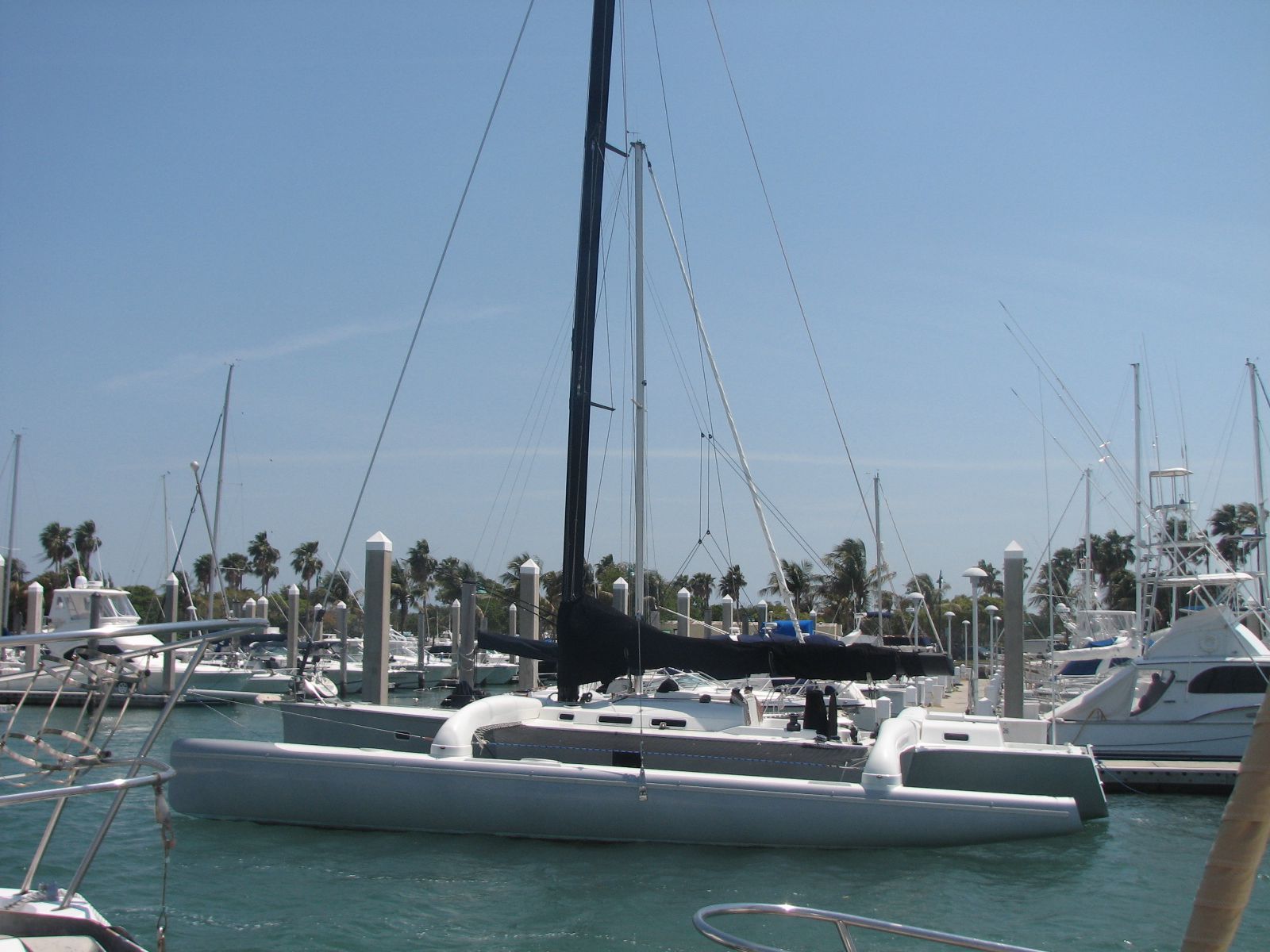
Designed by Cole Beadon, the Contour 30 MkII is a refinement of the original Contour 30, of which 41 have now been sold worldwide. Built by Contour Yachts of Ontario, Canada, the new 30 interestingly blends both performance and comfort features. One of the first questions that comes up with any trimaran is, "Where do you park it?" Contour has attacked this problem by reducing an overall beam of 23 feet, 10 inches to 8 feet, 6 inches through the use of retracting amas.
Contour folds the amas inward to lie slightly deeper when retracted and in the same waterplane as when extended. This provides stability and allows for freer movement around the boat when retracted. The downside to this method is that the amas need to be removed in order to prepare the boat for trailering, adding a half-hour to the process (although it can be done without any major heavy lifting). Simply retracting the amas can be done in less than a minute by one person.
The highly flared main hull has lots of rocker and a waterline-to-beam ratio of 8.3. The prismatic of the main hull is .61, which is high and intended to give the 30 top-end speed. The prismatic coefficient is a measurement of volume in the ends of the hull relative to the volume amidships. A high prismatic means the ends are full. A low prismatic means the ends are fine. You need a high prismatic for high speed and a low prismatic for light-air speeds. The stern sections are full to help prevent pitching. The amas, when fully immersed, represent 180 percent of the total displacement. The D/L is 59.5.
The high-profile cabintrunk gives the 30 a standing headroom of 6 feet, 2 inches and there is a double berth forward with sitting headroom. The settees convert to 6-foot-3-inch berths. You do not need to walk through the head to get to the forward berth. No doubt about it, it is a snug interior, but there must be some trade-offs for speed. Remember, we are only talking about 3,250 pounds of total displacement. The galley takes up the space aft of the settees and runs along under the bridgedeck. Cooking will be done on a one-burner Origo alcohol stove.
The rig, designed by North Sails, was the first step in progressing from the original Contour 30 to the new MkII version. The main has lots of roach, giving it an efficient elliptical shape. The jib is self-tacking. This combo gives the 30 an SA/D of 41.56 including the roach of the main. Keep in mind that up until now we have based SA on I, J, E and P dimensions without benefit of main roach. As we start to see roach increase, especially in multihulls, it will be necessary to add the area gained by a full roach to these basic dimensions to get a clearer picture of the rig's power potential.
For instance, SA without roach is only 383 square feet compared to 570 with roach. This high SA/D certainly will be enough to overcome the high prismatic in light air. A pivoting mast will further enhance performance.
Construction of the 30 uses unidirectional roving with Kevlar reinforcement over both Contour-core balsa and Klegecell foam cores. The amas have three watertight flotation chambers.
If sailing at 15 knots sounds like fun to you, you're in good company. Combine this with the ability to trail the boat and you begin to have an attractive package. The fact that the Contour 30 MkII is an improved version of an already proven performer just makes it more attractive.
Boat Specifications
| LOA | 30' |
| Beam | 23'10" |
| Draft | board up 1'4", board down 5'9" |
| Displacement | 3,250 lbs. |
| Sail Area | 570 sq. ft. |
| SA/D | 41.56 |
| D/L | 59.5 |
| W/B | 8.3 |
| Auxiliary | 9.9-horsepower outboard |
| Water | 20 gals. |
 This story originally appeared in Sailing Magazine, and is republished here by permission. Subscribe to Sailing.